In today’s connected world, offering guest Wi-Fi is no longer an optional service – it’s an expectation. Whether you operate a café, hotel, retail store, university, or mall, customers rely on seamless connectivity. But with Wi-Fi access comes responsibility. Any time you collect, store, or analyze customer data, privacy laws come into play.
One of the most influential of these regulations is the GDPR – the General Data Protection Regulation, which protects individuals’ personal data and sets strict requirements for organizations.
This article breaks down what GDPR means for businesses offering guest Wi-Fi and explains how Monyfi, a cloud-based Wi-Fi management platform, helps you stay compliant while still delivering great digital experiences.
What Is GDPR? (In Simple Terms)
The GDPR is a data privacy law created in the European Union (EU) to protect personal data. Even if your business is not located in the EU, you may still fall under GDPR if:
- An EU customer connects to your Wi-Fi
- You collect or process data belonging to an EU visitor
The law is built around clear principles:
- Transparency – People must know what data you collect and why
- Purpose limitation – You can only use data for clearly stated reasons
- Data minimization – Collect only what you truly need
- Security – Protect data from misuse or breaches
- Accountability – Document your processes and policies
Here’s a short video that explains GDPR visually and helps you understand how data protection works behind the scenes:
What Data Does Guest Wi-Fi Collect?
A Wi-Fi management platform like Monyfi can collect various types of data, depending on how the business configures the system. Examples include:
Technical & Device Data
- Device MAC address
- Connection times and duration
- Bandwidth usage
- Access point location
User-Provided Data (if login is required)
- Name, email, phone number
- Social login information
- Survey responses
- Voucher redemption data
Engagement & Behaviour Data
- Advertising or campaign interactions
- Footfall and visit patterns
- Session frequency (new vs returning user)
All of this falls under personal data under GDPR, meaning it must be processed lawfully and responsibly.

GDPR Compliance Checklist for Guest Wi-Fi Networks
To stay compliant, businesses must follow a few key requirements:
1. Be Clear and Transparent
Your splash or welcome page must show:
- What data you collect
- Why you collect it
- How long you keep it
- Who you share it with
- A link to your Privacy Policy
2. Choose a Lawful Basis for Data Collection
There are two common lawful bases for Wi-Fi environments:
Consent
Used mainly when:
- Collecting emails for marketing
- Running Wi-Fi advertising campaigns
- Gathering detailed analytics
Consent must be freely given and clearly recorded.
Legitimate Interest
You can justify collecting minimal technical data for:
- Allowing customers to access Wi-Fi
- Ensuring network security
- Preventing misuse

3. Limit the Data You Collect
Gather only the information required for functionality or your stated business purpose.
4. Give Users Control
You must provide:
- The ability to opt out of marketing
- The right to access their data
- The right to request deletion
5. Secure the Data
Your business must take appropriate security measures, such as:
- Strong encryption
- Access controls
- Regular audits
6. Set Retention Periods
Data should not be stored longer than needed. Define:
- How long Wi-Fi session logs are kept
- How long customer details remain in your database
7. Document Everything
GDPR requires businesses to keep internal documentation of:
- Data processing activities
- Policies
- Consent logs
- Technical controls
Country-Specific GDPR & Guest WiFi Requirements
United Kingdom (UK)
Following Brexit, the United Kingdom introduced the UK GDPR, which closely mirrors the EU GDPR with only minor differences. For businesses offering guest WiFi – such as cafés, hotels, restaurants, and co-working spaces – the compliance expectations remain almost identical to the EU system.
UK businesses offering guest WiFi must:
- Provide clear and accessible privacy notices
- Collect only the minimum data required for WiFi access
- Protect user information with appropriate security measures
- Allow users to request access, correction, or deletion of their data
This ensures that UK organizations remain fully aligned with GDPR-style privacy requirements, even outside the European Union.
European Union (Germany, France, Italy, and others)
Across all EU member states, businesses providing guest WiFi must fully comply with the GDPR. Although the law is harmonized across the EU, enforcement levels can differ by country. For example, Germany is known for stricter interpretations of data minimization and retention, while France enforces strong requirements for user consent and transparency.
Guest WiFi providers in EU countries must:
- Clearly explain what data is collected and why
- Avoid collecting unnecessary personal information
- Use appropriate technical and organizational security measures
- Ensure data is deleted once it’s no longer needed
- Offer users full control over their personal data
This applies to any business offering free or paid WiFi access, including cafés, hotels, restaurants, malls, transport hubs, and co-working spaces.
United Arab Emirates (UAE)
The UAE has implemented its own federal data protection law, the Personal Data Protection Law (PDPL). While GDPR does not apply directly, GDPR obligations still arise if EU citizens use guest WiFi within the UAE.
This means hotels, cafés, malls, airports, and restaurants in the UAE should prepare for dual responsibilities: complying with the UAE PDPL and respecting GDPR requirements for EU visitors.
UAE businesses offering guest WiFi should:
- Inform users what personal data is being collected
- Avoid collecting data that is not required for WiFi access
- Secure WiFi access logs and system data
- Maintain transparent user-data practices
This is especially important in high-tourism areas like Dubai and Abu Dhabi.
United States (CCPA & Other State Privacy Laws)
GDPR does not apply directly to U.S. businesses.
However, if EU residents use your guest WiFi, you are still responsible for meeting GDPR obligations related to their personal data.
In addition, U.S. companies must consider local state-level privacy laws, which are becoming increasingly strict:
- California Consumer Privacy Act (CCPA)
- Virginia Consumer Data Protection Act (VCDPA)
- Colorado Privacy Act (CPA)
- (Plus additional laws emerging in other states)
U.S. businesses offering guest WiFi should:
- Provide transparent notices to all users
- Minimize data collection
- Offer opt-out or data-access rights where required
- Ensure strong protection for connection logs and device data
This dual consideration – GDPR for EU users and state privacy laws for U.S. residents – is especially relevant for hotels, cafés, airports, and tourist locations.
How Monyfi Helps You Stay GDPR-Aligned
While GDPR compliance is ultimately the responsibility of each business, Monyfi gives you the tools to manage your Wi-Fi network in a way that supports privacy and transparency.
Here’s how:
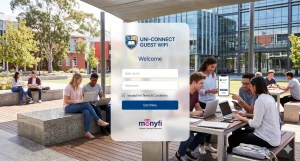
1. Customizable Branded Welcome Portal
Monyfi allows you to fully customize your splash page so you can:
- Display privacy notices
- Add consent checkboxes
- Link to your privacy policy
- Explain what data is collected
This ensures users know exactly what they’re agreeing to.
2. Control Over What Data You Collect
Monyfi enables you to choose:
- Whether you want to collect emails
- What fields appear on login
- Whether to activate analytics
- Whether to use vouchers or ads
You can simply disable features you don’t need.
3. Clear Data Records for Business Auditing
The platform provides structured logs and analytics that help businesses:
- Understand what data has been collected
- Demonstrate compliance
- Generate reports if needed
4. Ability to Manage Data Retention
You can configure retention periods depending on your local policies – a key GDPR requirement.
5. Marketing Tools with Compliance in Mind
Features such as targeted ads, vouchers, and campaigns can be used only when users give valid consent, helping reduce risk.
Industry Examples: Why GDPR Matters Across Sectors
Monyfi supports a wide range of industries – each with unique data considerations:
- Hospitality: Guest data, visitor patterns, loyalty marketing
- Universities: Student device tracking, secure access
- Shopping malls: Footfall analytics, campaign engagement
- Smart buildings: Occupancy insights
- Retail & Cafés: Loyalty promotions, customer behavior
- Airports & Venues: High traveler data volume
In each scenario, GDPR applies when collecting personal data – making it essential to implement careful controls.
Best Practices When Using Monyfi to Stay Compliant
Here are simple steps every business should follow:
- Add a clear privacy statement to your splash page
- Only request data that truly matters
- Use separate consent checkboxes for marketing
- Review your data retention settings regularly
- Train your staff on basic data protection
- Keep your privacy policy updated
- Avoid collecting unnecessary sensitive information

FAQ: Quick Answers for Businesses
What is GDPR?
GDPR (General Data Protection Regulation) is a data privacy law created by the European Union to protect personal data. It sets rules for how businesses collect, store, and use customer information. Even businesses outside the EU must follow GDPR if they process data belonging to EU visitors – including guests who connect to your Wi-Fi.
Is guest Wi-Fi data covered by GDPR?
Yes. If the information identifies or relates to a person, GDPR applies.
Do I need consent for analytics?
For basic connection data, no.
For marketing or personalized analytics, yes.
Can I collect emails for newsletters?
Yes – but only with explicit consent.
What should I include on the Wi-Fi login page?
A short privacy summary + link to the full policy + consent options where needed.
Does GDPR apply if my business is not in the EU?
Yes, if an EU resident connects to your network.
Conclusion
Guest Wi-Fi is a powerful tool for improving customer experience, driving engagement, and generating insights. However, it also comes with the responsibility to protect user data and follow privacy laws like GDPR.
With Monyfi, businesses gain a flexible and secure Wi-Fi management system that supports transparent data practices – helping you stay compliant while still unlocking the full potential of your network.
If you’re ready to offer smarter, safer Wi-Fi for your customers, Monyfi makes it simple.